
SK Resources / Products & Solutions / Technology / Electrical
Squirrel cage rotor, 400/690, 0.3
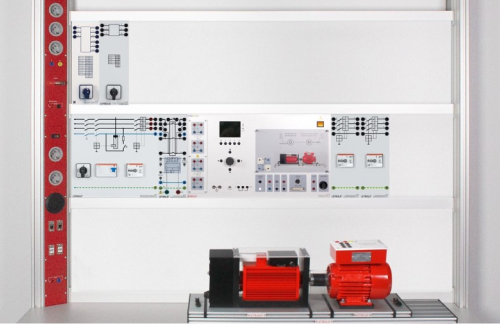
E2.2.4.1In this system, the operation and steady-state operating behaviour of an electric asynchronous machine with a squirrel-cage rotor are investigated. Special attention is paid to the termination, the rated values, the efficiency determination and the machine characteristic curve.
Description
Experimental procedures are carried out with industrially manufactured machines. All test machines have a special base for termination to the machine test CASSY 0.3. All measured values of the alternating current machines are recorded with the machine test CASSY. The measured values can be shown directly on the built-in display as a single value, table of a measurement series or diagram. The measurements can be taken without additional software and the measurement data can be saved locally on the device. The machine test CASSY is used to record the characteristics of the test machines. The power supply for the test machines is partly provided directly from the public supply network.
Learning objectives
- Protective measures and electrical safety.
- Setup and commissioning of electrical machines.
- Use of starting circuits.
- Machine efficiency.
- Assessment of characteristic curves of electrical machines.
Asynchronous machines as squirrel cage rotors are widely used. These are particularly low-maintenance motors. The asynchronous motor in this configuration has the suffix 400 / 690 V; it can be used in cyclical operation 230 V / 400 V delta network. This motor is suitable for star-delta starting.
Highlights
- To protect against overheating, the stator windings of the test machines are equipped with thermal detectors.
- In the event of overheating, the machine test system switches off the load of the test machine, thereby maintaining air cooling. This prevents damage to the test machines.
- The test machines have a didactic terminal board with the winding diagram printed on it.
- All winding ends are led out to safety sockets (4 mm) on the terminal board.
- Computer-aided data acquisition provides meaningful measurement results.
- The arrangement of the 4 mm safety sockets complies with the standards for industrial motors.